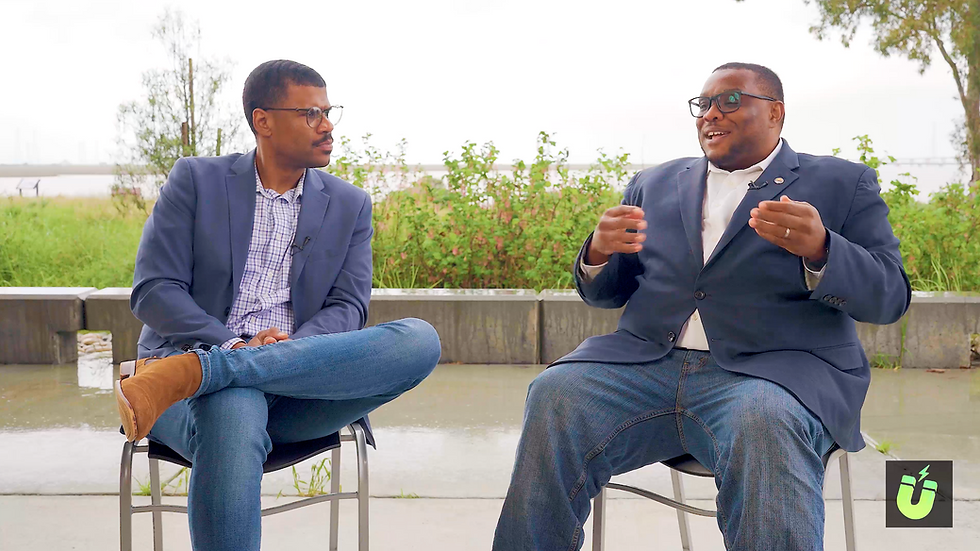
East Palo Alto's Mayor talks Brand Narrative Strategy

Updated: 2 hours ago
Key takeaways
|
Every brand has a story the market tells about them, and it's rarely the story they'd choose. For East Palo Alto, that story has been written in crime statistics and poverty headlines for decades. The city sits in the shadow of some of the wealthiest zip codes in America, and the narrative the outside world constructed was defined by what East Palo Alto lacked rather than what it had. In more than 16 years of B2B content marketing, I've never seen a harder brand storytelling problem.
On Magnetic, I asked Mayor Webster Lincoln where he started when he inherited a narrative he didn't write. Because rewriting a market narrative is one of the hardest challenges in communications, and it's one that companies, cities, and individuals face constantly.
What is a brand narrative strategy?
A brand narrative strategy is a deliberate plan for shaping the story the market tells about you. When that story is outdated or unfair, the durable approach is additive rather than substitutive. You don't deny the old story or suppress it. You expand the frame with new evidence, new stories, and new proof points until the full picture shifts perception. |
Understand why the old narrative stuck
Mayor Lincoln's approach begins with something most rebranding efforts skip. Understanding why the old narrative existed in the first place. You can't overwrite a story without understanding what made it sticky. The crime statistics and poverty headlines stuck because they were real data points, reported by credible sources, reinforced over years. Fighting that narrative by insisting it was wrong would have been futile.
That's a data scientist's instinct as much as a communicator's, the same discipline behind his data-driven storytelling and his approach to finding the signal in the noise. Diagnose the perception before you try to treat it.
Expand the frame instead of fighting the story
Mayor Lincoln chose a different strategy. He didn't deny the city's history. He recontextualized it. He told the story of East Palo Alto's resilience, its culture, and its community bonds, the parts of the story the outside narrative never included. Not to replace the hard truths, but to expand the frame so the full picture could emerge.
The smarter approach is additive, not substitutive. The old story doesn't disappear just because you stop telling it. Other people are still telling it. So you expand the narrative to include new evidence, new stories, and new proof points that gradually shift the overall perception. It's slower than a rebrand, but it's more durable, and it compounds the same way brand awareness does. Every new chapter makes the next one easier to believe.
Authenticity is the license to lead the shift
Mayor Lincoln's credibility in leading this narrative shift comes from his authenticity as a third-generation resident. He's not an outside consultant telling East Palo Alto what its brand should be. He's someone who grew up in the story and has the standing to add new chapters. Brands need the same license. Narrative shifts announced by people with no history in the story get read as spin, which is why O'Reilly Media's brand consistency through decades of business model pivots worked. The storyteller never changed, so the story could.
Why additive beats substitutive for B2B brands
If your company has been defined by a product failure, a security incident, a bad review, or a market perception that no longer reflects reality, the instinct is to suppress the old story and replace it with a new one. Mayor Lincoln's experience shows why that doesn't work, and the math of attention explains why patience pays.
The Ehrenberg-Bass Institute's 95-5 rule, cited in Edelman and LinkedIn's B2B Thought Leadership Impact Report, holds that around 95% of your category's buyers aren't in market at any given moment. They're forming memory, not evaluating claims. An additive narrative keeps depositing proof points into that memory so the frame has already widened by the time they're ready to buy.
And substance can outrun reputation. The same Edelman and LinkedIn research found 53% of B2B decision makers say strong thought leadership makes brand recognition matter less. New evidence, told well and consistently, genuinely moves perception. That's the engine behind building authority through thought leadership content, and it's how Mayor Lincoln keeps widening his city's frame, from messaging through public conflict to the competitive positioning lessons of his upset victory.

Watch the full conversation
For communications professionals working on reputation management, brand repositioning, or crisis recovery, this clip offers a strategic framework tested in one of the most challenging narrative environments imaginable.
If you can shift the perception of a city that's been stereotyped for decades, you can shift the perception of anything. Watch it, then think about the narrative your market tells about your brand, and whether you're fighting it or expanding it.
If your brand is carrying a story it didn't choose, book 30 minutes with me and we'll map the frame expansion.
Keep reading
Frequently asked questions
What is a brand narrative strategy?
A brand narrative strategy is a deliberate plan for shaping the story the market tells about you. When that story is outdated or unfair, the durable approach is additive rather than substitutive. You don't deny the old story or try to suppress it. You expand the frame with new evidence, new stories, and new proof points until the full picture shifts perception.
How do you change a negative brand perception?
Start by understanding why the old narrative stuck. Negative perceptions usually rest on real data points reported by credible sources, so insisting they're wrong is futile. Recontextualize instead. Keep telling the hard truths while adding the parts of the story the outside narrative never included, and let the expanded frame do the work over time.
Why is an additive narrative more durable than a rebrand?
Because the old story doesn't disappear when you stop telling it. Other people are still telling it. A rebrand tries to overwrite memory. An additive narrative builds alongside it, so every new proof point compounds instead of competing with the past. It's slower, but the perception shift holds.