Messaging Across Personas and How to Bridge Experience Gaps

Updated: 2 hours ago
Key takeaways
|
Every content marketer faces a version of this problem. You're writing for the VP who thinks in quarterly pipeline and for the engineer who needs to know which button to click. Somehow it has to resonate with both. In more than 16 years of B2B content marketing, I've watched most teams get this wrong the same way. They write separate content for each audience instead of finding the message that connects them.
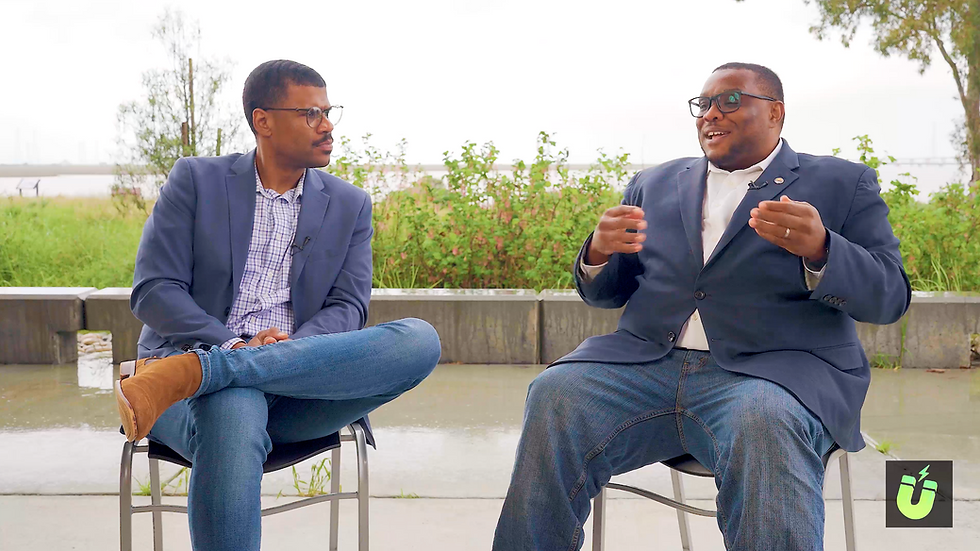
Mayor Webster Lincoln faces the extreme version. East Palo Alto's city council includes members who've served since the city's founding in 1983 and members elected recently. That's a forty-year experience gap at the same table. The founding members remember the incorporation fight and the early battles against annexation. The newer members arrived in a different context entirely. On Magnetic, I asked him how he crafts messages that resonate across that divide.
What does messaging across personas mean?
Messaging across personas means crafting one core message that resonates with different audiences at once, such as an executive buyer and a technical evaluator. Instead of separate content per audience, you anchor on the outcome both personas share and route the details where they diverge into supporting content. The goal is highest common ground, not lowest common denominator. |
How to bridge a 40-year experience gap at one table
Mayor Lincoln's answer speaks directly to one of the most persistent challenges in B2B communication. How do you create a messaging strategy that works for decision makers at wildly different stages of their journey with your brand? His approach starts with respect. Not lip-service respect, but the genuine understanding that each generation's perspective is grounded in real experience.
The founding council members aren't resistant to change because they lack vision. They're cautious because they remember what it cost to build what exists. The newer members aren't naive. They're bringing fresh urgency to problems that have calcified over decades. If you've done real work on B2B buyer personas, you'll recognize the pattern. Every persona's resistance has a rational source, and the most common messaging mistake is ignoring it in favor of what you want to say.
How to anchor on outcomes, not approaches
The messaging insight is that you don't bridge a divide by splitting the difference. You bridge it by finding the shared value both groups care about and expressing it in language each group recognizes as its own. When Mayor Lincoln talks about improving quality of life for East Palo Alto residents, the forty-year veteran hears continuity with the city's founding mission. The recent arrival hears a commitment to forward progress. Same words, different resonance, because the outcome is shared even when the context is different.
This is the principle that makes a multi-persona messaging framework work in B2B. Lead with the outcome your personas share. Reduced risk, faster time to value, competitive advantage. The executive and the practitioner both hear a message that speaks to them, and the specifics of how you deliver it live in supporting content mapped to each stage of the content marketing funnel.
Why this matters for the B2B buying committee
The stakes are structural. Gartner's buying journey research puts the typical B2B buying group at six to ten decision makers, each arriving with independently gathered information and different priorities. The buying committee is bigger and quieter than you think, and a message that only lands with one persona leaves the rest unconvinced. Unconvinced committees default to doing nothing.
Your executive buyer and your technical evaluator don't just have different priorities. They often have fundamentally different relationships with the problem space. The executive sees a strategic opportunity. The practitioner sees an operational headache. Both are right, and Sharon Cordesse's advice on selling to different buyer motivations pairs perfectly with Mayor Lincoln's framework here. Honor both perspectives without seeming like you're trying to be everything to everyone.
How to build a messaging framework that travels
Start by writing the outcome statement that every persona in your committee would agree to. Then pressure-test it. Does the CFO nod? Does the admin who'll live in the tool every day nod? If either hesitates, you've anchored on an approach instead of an outcome.
This is also where a documented positioning and messaging strategy earns its keep, because it keeps every writer and every campaign anchored to the same higher ground. And when the room itself pushes back, the companion skill is an executive buy-in strategy that maps each stakeholder's resistance before you present.

Common mistakes in multi-persona messaging
Most multi-persona messaging fails in one of three predictable ways.
The first is averaging. The team writes a message general enough that nobody objects, which also means nobody feels spoken to. A message that's safe for the whole committee is usually invisible to each person on it.
The second is splitting. Every persona gets its own message, and the messages quietly contradict each other. The executive hears speed, the engineer hears stability, and when they compare notes in the buying meeting, the story falls apart. Mayor Lincoln's approach avoids this by keeping one outcome at the center and changing only how it's expressed.
The third is ranking. The team writes for the most senior persona and treats everyone else as an afterthought. In a buying group, the person with the least formal authority can still stall the deal, which is why an executive buy-in strategy has to account for every seat at the table, not just the one with the budget.
Watch the full conversation
This clip closes my conversation with Mayor Lincoln on Magnetic, and it's fitting that it ends here. The ability to communicate across divides, generational, experiential, and philosophical, is the ultimate test of a magnetic communicator. Watch it if you've ever struggled to write a single message that resonates with different audiences. It's not about finding a middle ground. It's about finding higher ground.
If your team is wrestling with messaging that has to work for a whole buying committee, book 30 minutes with me and we'll find your higher ground.
Keep reading
Frequently asked questions
What does messaging across personas mean?
Messaging across personas is the practice of crafting one core message that resonates with different audiences at once, such as an executive buyer and a technical evaluator. Instead of writing separate content for each audience, you anchor on the outcome both personas share and let supporting content handle the details where they diverge.
How do you write for multiple buyer personas at once?
Anchor on outcomes rather than approaches. Identify the result every persona wants, like reduced risk or faster time to value, lead with that shared outcome, and route persona-specific detail into supporting content. The goal is highest common ground, not lowest common denominator.
Why does multi-persona messaging matter in B2B?
Because B2B decisions are made by groups, not individuals. Gartner puts the typical buying group at six to ten decision makers, each with different priorities and different relationships with the problem. A message that only speaks to one persona leaves the rest of the committee unconvinced, and unconvinced committees default to doing nothing.
What is the most common mistake in multi-persona messaging?
Averaging the message until nobody objects to it. A message general enough for the whole buying committee usually fails to speak to anyone on it. The better approach is one shared outcome at the center, expressed in each persona's own language, so the story stays consistent when the committee compares notes.
Should each buyer persona get a different message?
Each persona should get a different expression of the same message, not a different message. Change the vocabulary, the proof points, and the level of detail, but keep the core outcome identical. Separate messages that contradict each other tend to surface in the buying meeting, where they undermine trust in the whole proposal.